BOOK PROJECTS
Factories of Modernity: Global Thought in the Capitalist Epoch
My first book, Factories of Modernity: Global Thought in the Capitalist Epoch, argues that the factory system acted as a decisive stage for the historical development of international political thought and practice across Britain and the Atlantic world from 1688 to 1807. Moving between canonical texts and unpublished manuscripts, each of my chapters presents an image of the factory as a microcosm of modernity by turning to texts and spaces in which capitalism was originally articulated and practiced, both by political thinkers and a range of lesser-known political actors, from factory owners, inventors, and colonial officials to painters, abolitionists, and free workers of color who resisted Atlantic slavery in the late eighteenth century. By reading these perspectives as forgotten archives of capitalist modernity, I show that factories are not restricted to the giant assembly plants of nineteenth-century Britain. Rather, the historical spaces I call “factories of modernity” encompass an unfamiliar plurality of pre-industrial environments—workhouses, manufactories, plantations, colonies—where labor was performed, reproduced, and disciplined. In redefining the factory as a multiplicity of spaces in which influential ideas and ordinary experiences of labor, aesthetics, and race were co-constituted, I provide an alternative account of capitalist society that discloses and confronts the salient yet neglected ways in which corporations at the heart of our “postindustrial” economy—Google, Amazon, and Apple among them—are organized through a racialized politics of factory production.
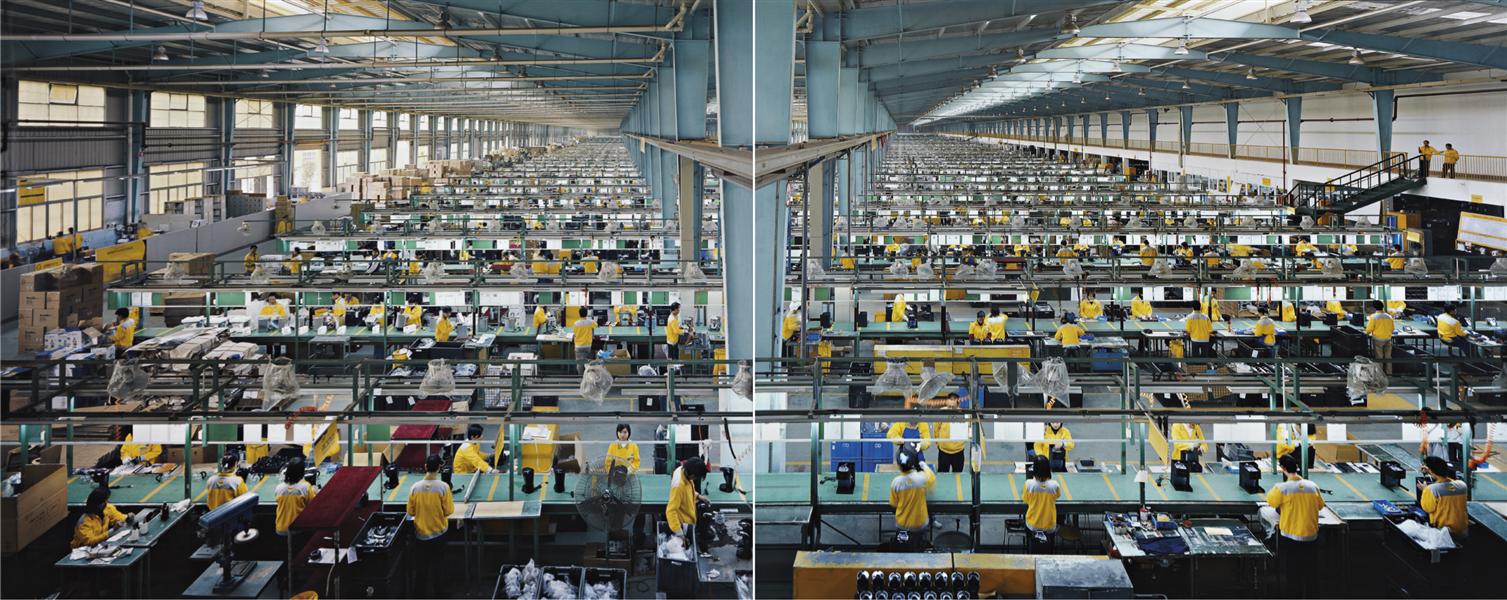 Edward Burtynsky, “Manufactured Landscapes,” Cankun Factory, Xiamen City, China (Digital Photo, 2005)
Badlands of Utopia: Political Theory and the Lost Futures of Work
My second book project, Badlands of Utopia: Political Theory and the Lost Futures of Work, explores how notions of idleness, laziness, and waste were part of a conceptual grammar of progress, development, and growth upon which an array of early modern British utopian thinkers and projectors relied to articulate their visions of work in model societies to come. Each chapter pairs a detailed study of early modern utopian thought with a historical examination of “projects” for utopian societies proposed and enacted by a range of visionaries. In showing how utopian authors—including Thomas More, Francis Bacon, James Harrington, Daniel Defoe, and Robert Owen—developed new norms of scientific, agrarian, and industrial work as remedies to both the socioeconomic and moral crises of their days as well as the perceived shortcomings of certain populations, from native Americans to England’s idle poor, I recover neglected synergies between early modern utopian fictions and real attempts by imperialists, merchant adventurers, and social reformers to create utopian communities across the Atlantic world from the seventeenth through the nineteenth centuries. In doing so, the book foregrounds the ways in which utopian ideas and projects consigned certain people—slaves, the unemployed, convicts, black refugees, and indentured natives—to what I call the “badlands of utopia.” Rather than abstract thought experiments, I argue that utopias were the foundation of historical discourses and practices invested in fashioning industrious workers out of populations who, on account of their alleged “idleness” and “laziness,” were said to leave their labor-power and natural resources in a condition of “waste” ripe for capitalist and colonial regimes of extraction, expropriation, dispossession, and exploitation.
PUBLICATION & WORKS IN PROGRESS
Peer-Reviewed Book Chapter
“The Ableist Contract: Intellectual Disability and the Limits of Justice in Kant’s Political Thought,” Disability and Political Theory, edited by Barbara Arneil and Nancy J. Hirschmann (Cambridge and New York: Cambridge University Press, 2016), 43–78.
Journal Article Under Review
“A Factory Afield: John Locke, Imperial Commerce, and Proto-Industrial Capitalism,” Modern Intellectual History (Revise and Resubmit).
Book Manuscript in Preparation
“Factories of Modernity: Global Thought in the Capitalist Epoch.”
Review Essay in Preparation
Review of Onur Ulas Ince, Colonial Capitalism and the Dilemmas of Liberalism, Oxford University Press 2018, in Contemporary Political Theory (Invited to Contribute).
Academic Translations
Céline Spector, “Liberty,” The Cambridge Companion to Montesquieu. Cambridge: Cambridge University Press (Forthcoming).
Céline Spector, “Montesquieu and the History of Rights,” The Cambridge History of Rights, Vol. 4, edited by Jennifer Pitts and Dan Edelstein. Cambridge: Cambridge University Press (Under Contract).
Working Papers
“Absent Factories: Racialized Drudgery in High-Tech Capitalism.”
“Postindustrial Paradigm: The Demise of Factories in Critical Thought.”